· October / November
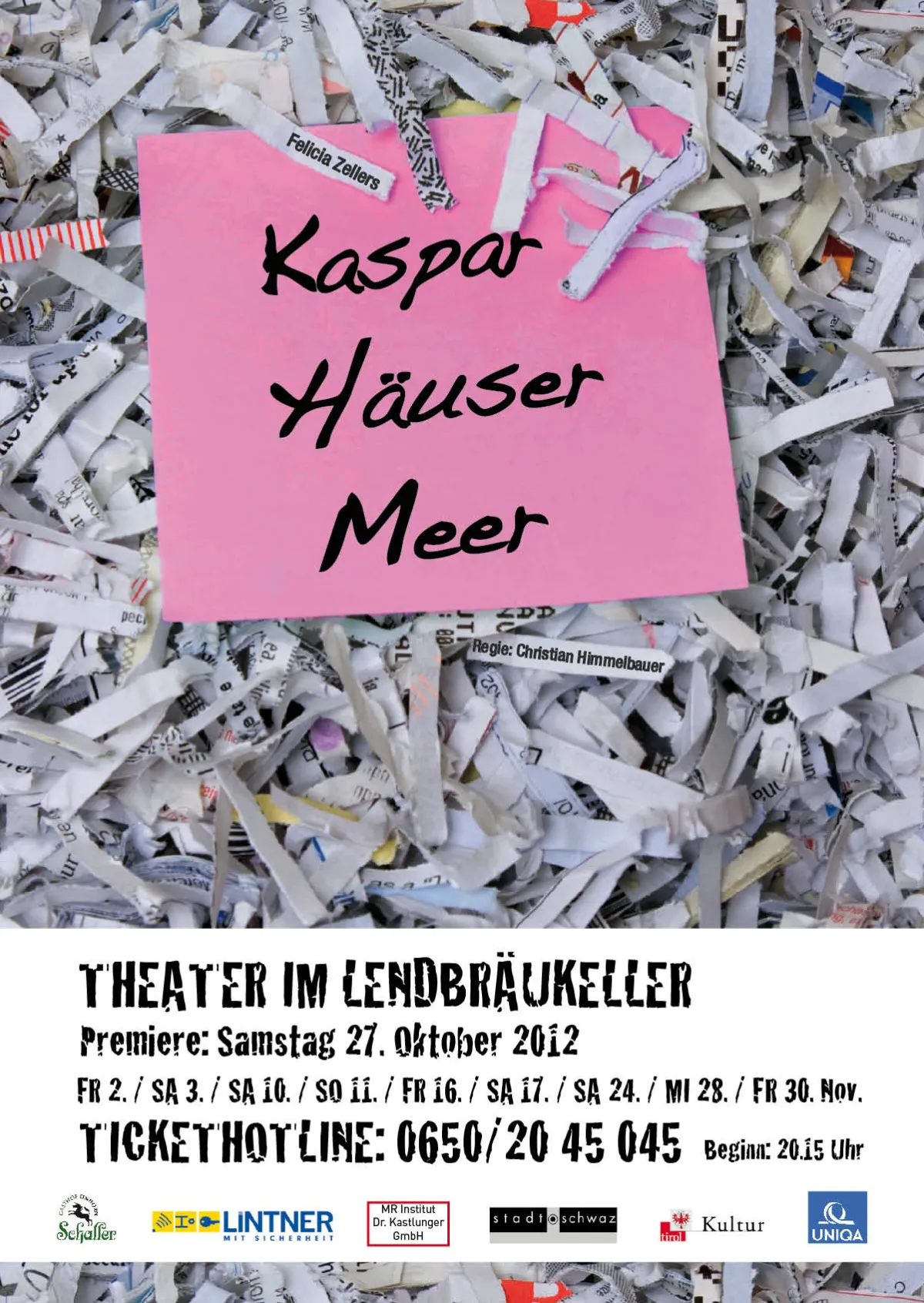
KASPAR HÄUSER MEER
by Felicia ZELLER THEATER IM LENDBRÄUKELLER Schwaz Role: Barbara Also starring: Caroline HOCHELNER (Anika) Anja PÖLZL (Silvia) Director: Christian HIMMELBAUER Set and costume design: Manuela MÜLLER Lighting design: Ralf WAPLER Sound design: Mike MOLL Lighting technician: Sebastian TREICHL Sound technician: Julia PEGRITZ Graphics: Tamara BAUMANN Press relations: Susanne SCHARTNER Photos: Kurt SCHARTNER Production: THEATER IM LENDBRÄUKELLER
THE "BJÖRN-OUT" SYNDROME
Brake at the front, throttle at the same time: the rear tyre spins. The rider keeps the throttle open for as long as possible to keep the tyre spinning for as long as possible: "BjÖRN-OUT".
WHOEVER IS BURNT OUT
MUST ONCE HAVE BEEN ON FIRE.
NOT ONLY THE CASEWORKER, BUT THE PARENTS TOO.
The award-winning play by Felicia Zeller is no realistic social drama but a screaming grotesque, a frantic, breathless spoken score for three women on the verge of a nervous breakdown.
LONGING FOR PREVENTION
The constant sense of "running late", the never-ending effort to chase after time that has already slipped away with ever more planning, this lagging behind while trying to be faster, shapes the working lives of the caseworkers in the General Social Services. The great longing for prevention, which can never be fulfilled, runs through everything they say and becomes manifest in the very form of their dialogue. One unfinished sentence piles on top of the next.
HELPING AT A RISK
Here, failure is not a scandal but a part of the job that has to be endured: helping at a risk. Not knowing how the help will turn out is a dilemma of social work that can only be understood and borne within the thinking of social pedagogy.
Writing a play about child abuse could easily have gone wrong. The risk of producing sentimental hand-wringing was too great. Felicia Zeller has not written an analysis of perpetrators but a grotesque about a burnt-out profession. And by repeatedly putting scraps of sentences from parents and neighbours into her characters' mouths, she paints a picture of a burnt-out society. A society that no longer has the strength for its own children.
PRESS
TIROLER TAGESZEITUNG (31 Oct. 2012)
DESPERATE AND SCATTERED (by Christiane Fasching)
.... Zeller's burnout play, which can be seen at the Theater im Lendbräukeller directed by Christian HIMMELBAUER (set design: Manuela MÜLLER), won the Audience Award at the Mülheim Theatre Days in 2008 – and rightly so. The virtuoso text gives the audience a glimpse into a world weighed down by regulations, one usually known only from horror headlines. Zeller shows that behind the limping bureaucracy are people who have their own burdens to bear.
At the Lendbräukeller, Susanne SCHARTNER, Caroline HOCHFELNER and Anja PÖLZL embody the "nice ladies" who can't go on and yet must. The cases they have to follow up are half-finished, as are the sentences they hurl around. Work follows them into their dreams, into their suicidal fantasies – for whoever hits rock bottom no longer has to worry that someone else is going under. Anja PÖLZL stands out from the trio, SCHARTNER gives a solid performance as the longest-serving colleague who copes with her frustration through travel fantasies, HOCHFELNER occasionally stumbles over the text, which swings between dialect and standard German.
"Kaspar Häuser Meer" is topical, explosive and well worth seeing....
BRENNPUNKT (8 Nov. 2012)
THE ART OF ACTING IN A CLASS OF ITS OWN (by Gabriele Maricic-Kaiblinger)
Oppressive, moving, shocking: Felicia Zeller's "Kaspar Häuser Meer" delves into the depths of everyday life and the souls of youth social workers who are confronted with the very worst every day. ... The author has created ... a screaming grotesque about a burnt-out profession, a frantic, breathless spoken score for three women on the verge of a nervous breakdown. .... Susanne SCHARTNER, Anja PÖLZL and Caroline HOCHFELNER – directed by Christian HIMMELBAUER – are challenged to peak performances in both speech technique and acting, which they more than live up to. Seemingly effortlessly, sensitively and expressively through and through, they embody the three social workers on the brink of "Björn-out syndrome", who do everything they can and yet cannot always do and prevent everything. .....