· February / March / June
DAS MISSVERSTÄNDNIS
by Albert CAMUS PROJEKTTHEATER HALL Role: THE MOTHER Further cast: Amarilla FERENCZY (Martha) Michael WALDE-BERGER (Jan) Tamara BURGHART (Maria) Heinz FITZ (The old servant) Director + set: Klaus ROHRMOSER Lighting + sound: Dietmar SCHERZ Design: Andrea SPIEGEL Theo MOSCHEN
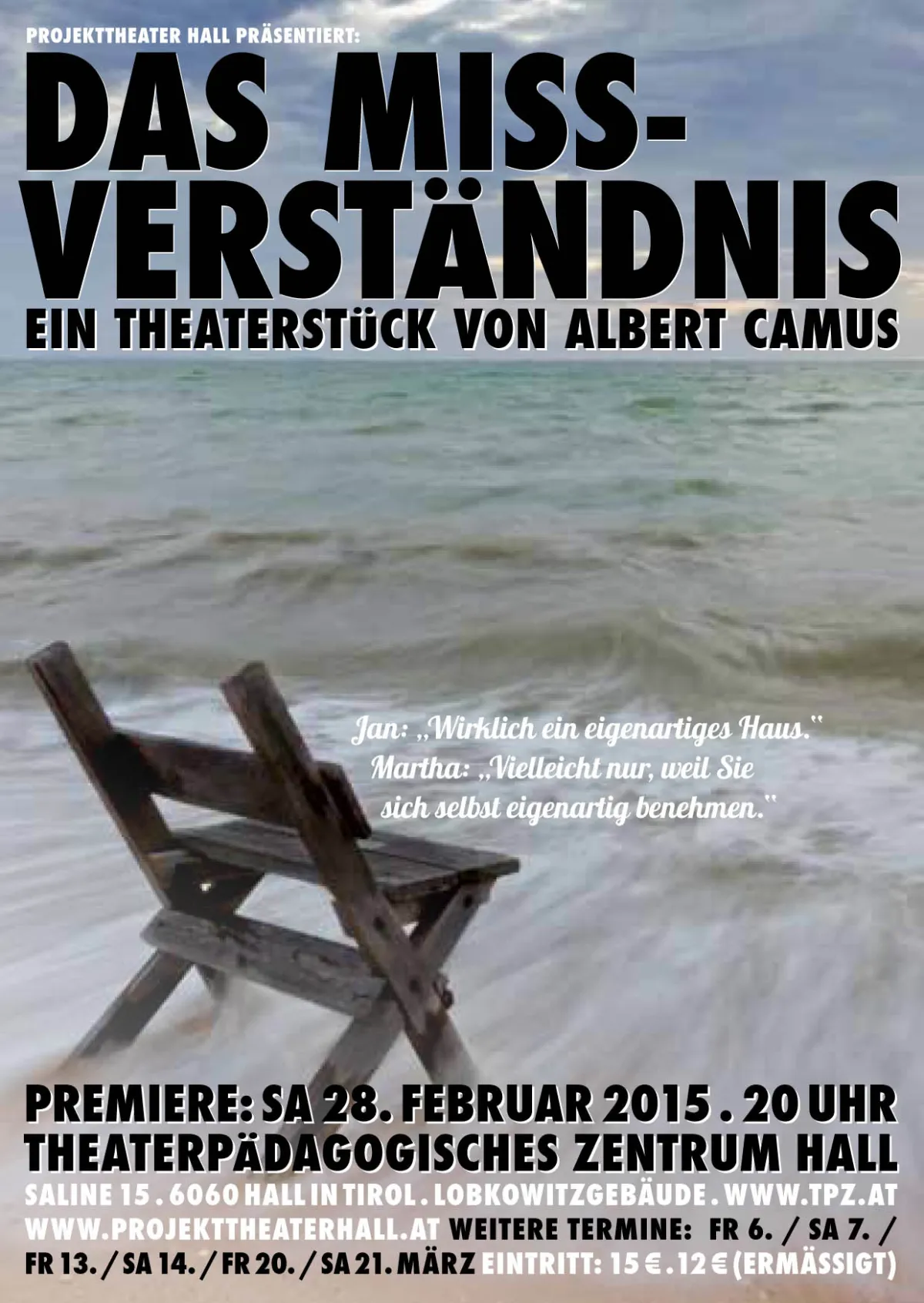
After twenty years away, Jan, who has meanwhile gained standing and wealth abroad, returns to his bleak home village. He takes a room at the lonely, run-down inn run by his mother and his sister Martha. Jan, however, conceals his true identity and hopes for a sign of recognition, waiting for the "right" word, a sign of love. But the two women, who share a dark secret, do not recognise him, and a misunderstanding ensues with fatal consequences …
Albert CAMUS was born in Algeria in 1913. He studied philosophy. In the mid-1930s he founded a theatre company, and he worked as a newspaper reporter until his critical articles against the oppression of the Arab population got him into trouble and he therefore left Algeria. During the Second World War he was active in the Résistance. He achieved his breakthrough as a writer in 1942/43 with the novel "The Stranger" and the essay "The Myth of Sisyphus". In 1957 he was awarded the Nobel Prize in Literature.
..."Das Mißverständnis is certainly a dark play. It was written in the midst of an enclosed, occupied country, far from everything I loved. It bears the colours of exile. But I do not believe it is a discouraging play. (...)
It would, however, be wrong to think, after the end of the tragedy, that this play argues for bowing to fate. On the contrary, it is a play of revolt and perhaps even contains a moral: sincerity! If a man wants to be recognised, he must simply say who he is. If he keeps silent or lies, he dies alone, and everything around him is doomed to misfortune. If he speaks the truth, he will of course still die, but before that he will have helped others and himself to live."(Albert Camus)
PRESS
TIROLER TAGESZEITUNG (3 March 2015)
FEVERISH, FATAL ATTEMPTS AT ESCAPE
... Camus wanted "to dress a tragedy of ancient force in a contemporary fable". "Das Missverständnis" is a case study of Camus' existential philosophy: all the protagonists strive – at times in morally questionable ways – to give their existence meaning. And fail. A cool refusal of meaning and consolation consequently also dominates Klaus Rohrmoser's sensitive staging of this rarely performed classic ... And although the fateful dimension of the entanglements is quickly revealed in the restrained décor (design: Andrea Spiegel and Theo Moschen), "Das Missverständnis" also works as a feverish crime chamber play. That one follows this fatal experimental set-up on the theme of speechlessness – after all, a clarifying confession would have prevented much – with suspense is also thanks to the committed ensemble: Michael Walde-Berger as the returning Jan, Susanne Schartner in the murderous role of the mother, Amarilla Ferenczy as his sister Martha, Tamara Burghart as the warning Maria and Heinz Fitz as the old servant wrest authentic moments from Camus' elaborate rhetoric. (jole)
BEZIRKSZEITUNG HALL(18 March 2015)
THE APOCALYPSE AS CHAMBER PLAY
A dense staging of "Das Missverständnis" at the Projekttheater Hall.
The coordinates of the action: a taproom, a guest room in a run-down inn (atmospherically designed byAndrea Spiegel & Theo Moschen), a mother-and-daughter team, a man who returns to his former home after a long time but wishes to remain unrecognised for now – which ends fatally, for he is murdered, unrecognised, out of base greed.
Klaus Rohrmosershapes the play into a merciless psychological thriller that manages with few loud notes, indeed creates dramatic moments precisely in the wordlessness of the old servant (impressively celebrated byHeinz Fitz).
Amarilla Ferenczy consistently masters the part of the victim's sister, determined to murder, though in some passages one wishes for a more powerful voice that also reaches the back rows.
Michael Walde-Berger gives the homecomer Jan a likeable and thoroughly credible shape, with Tamara Burghart acting on an equal footing as his admonishing American wife. ("Europe is so sad").
Susanne Schartner portrays the mother, disappointed by life, with clear contours. ("The heart wears out, sir")
Across four scenes the ensemble comes together effortlessly, Dietmar Scherzis responsible for the unobtrusive lighting and sound. Fatally, the framework of the story evokes associations with "Die Räuber vom Glockenhof" or "Das Wirtshaus in Spessart" – but – and this remains the magic of the brilliant author – the story mutates into a metaphor for an unimaginably cruel time (1942-1944). A great writer, an impressive chamber play. (Peter Teyml)